


Mock-up preparation to irradiate with laser


Mock-up laser irradiation
Q-Switched Quanta Ray INDI-series (Spectra Physiss)
Wavelength: 1064nm, 532nm, 355nm, 266n
Pulse duration: 6ns
Universidade de Vigo


1064nm


Laser AVIA Ultra 355-2000nm (Coherent)
Wavelength: 355nm
Pulse duration: 25ns
Universidade da Coruña


Laser Spirit System (Spectra-Physis)
Wavelength: 1040nm
Pulse duration: 380fs
Universidade da Coruña


Laser Nd:YAG Short free Running Quanta System Smart Clean II (El.En Group)
Wavelength: 1064nm
Pulse duration: 110ns
Centro Conservazione e Restauro “La Venaria Reale”


Laser Nd:YAG Long Q-Switched EOS 1000 (El.En Group)
Wavelength: 1064nm
Pulse duration: 100ns
Centro Conservazione e Restauro “La Venaria Reale”


Laser Nd:YAG Q-Switched Thunder Art (El.En Group)
Wavelength: 1064nm
Pulse duration: 8ns
Centro Conservazione e Restauro “La Venaria Reale”


Laser Yt-doped core Active Fiber Laser
Wavelength: 1064nm
Pulse duration: 30ns
Centro Conservazione e Restauro “La Venaria Reale”


Laser Er:YAG (El.En Group)
Wavelength: 2940nm
Pulse duration: 150ns
Università di Pisa


Laser Er-:YAG (El.En Group)
Wavelength: 2940nm
Pulse duration: 150ns (very short mode), 250ns (short mode), and 400ns (long mode)
Università di Pisa


Artificially ageing of the mock-ups
Universidade de Lisboa
Climatic Chamber Fitoclima 300EDTU (ARALAB) with gases exposure at the following conditions:
- Relative humidity: 80%
- Temperature: 18ºC
- [SO2]: 200 ppm
The prepared samples were exposed to SO2 in that equipment for 40 days


Aged mock-ups
Use of different lasers for the removal of a layer of diesel soot on painting mock-ups after being exposed for 40 days to an artificial ageing in a climatic chamber with exposure to SO2 gas.


Transfer results to real artwork
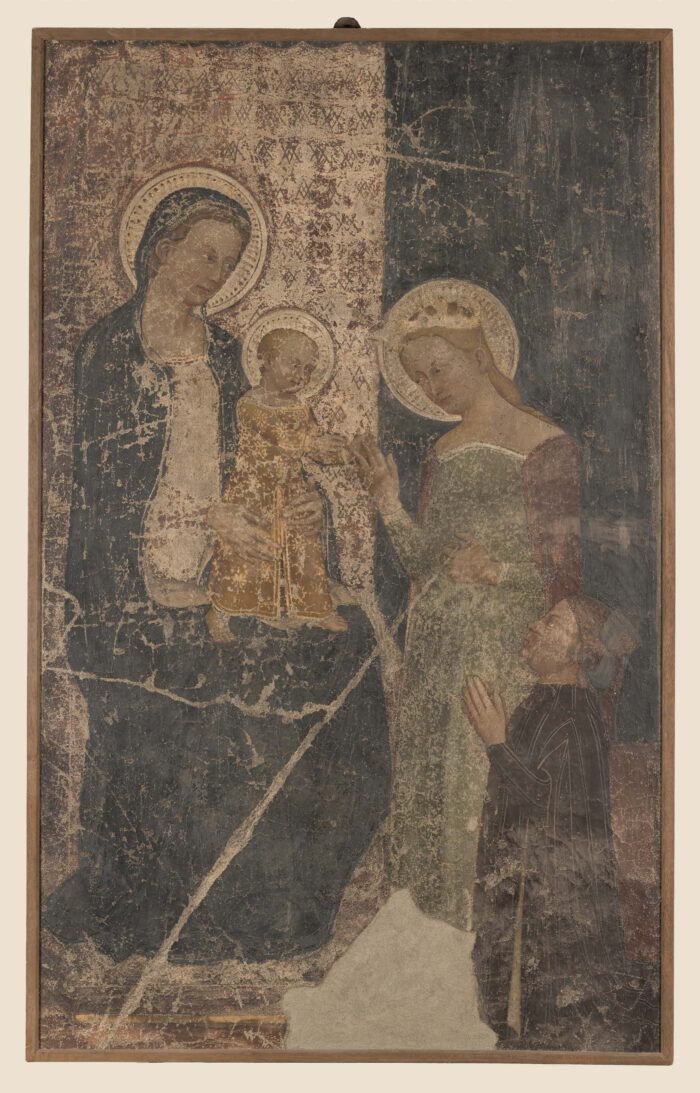
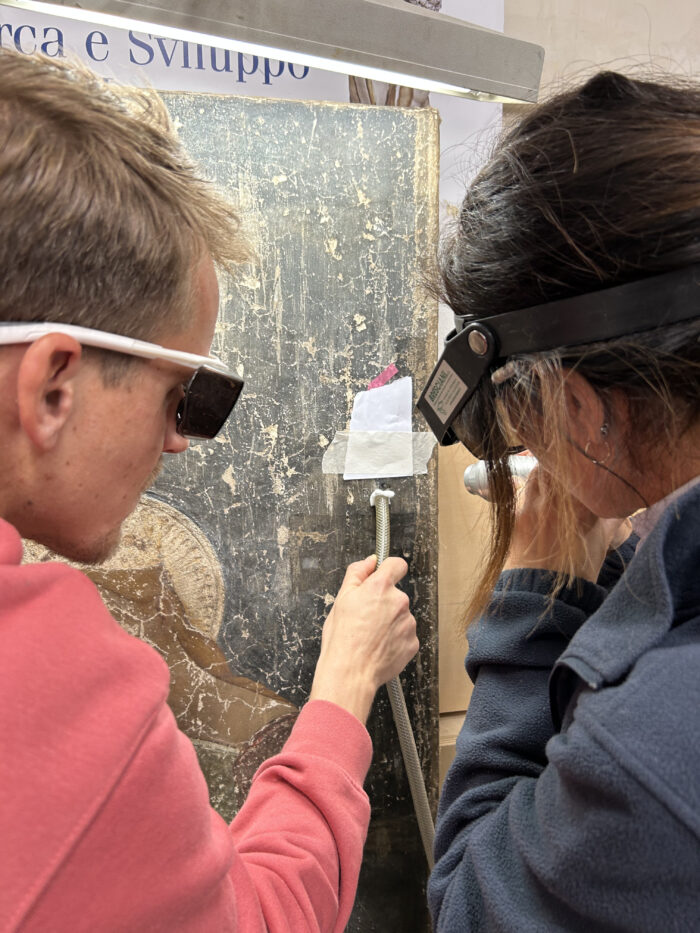
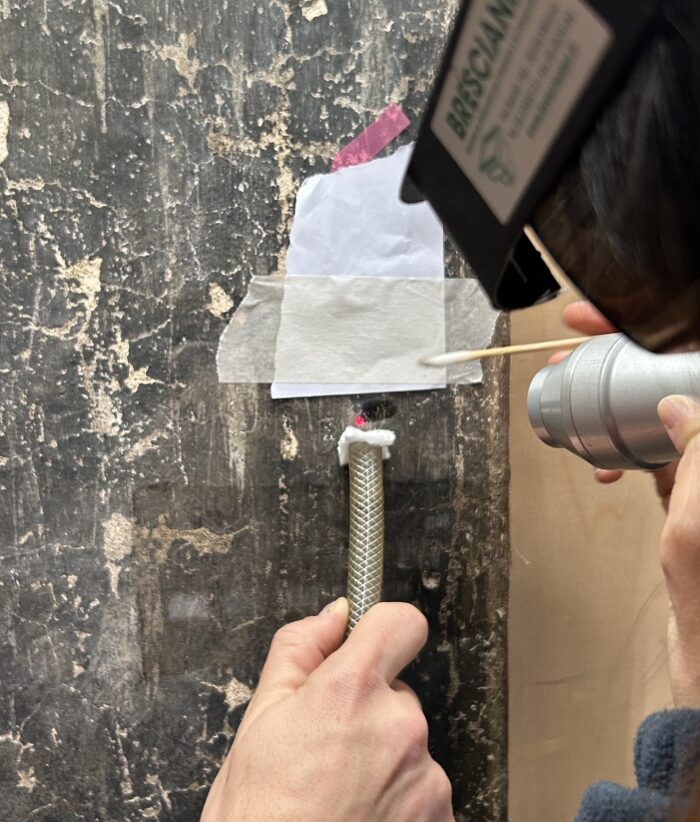
The final phase of the project focused on evaluating the use of laser technology for the cleaning of a historical artwork. Based on the results obtained in the previous phases, a LQS Nd:YAG laser operating at 1064 nm was selected for testing. The artwork examined is a detached wall painting (a stacco) entitled “The mystical wedding of St Catherine of Alexandria and devotee” (late 14th century), attributed to the Italian painter Pacino de Nova. The painting is owned by the Accademia Carrara of Bergamo (Italy) and is currently housed at the Centro Conservazione e Restauro “La Venaria Reale” in Turin (Italy), where the cleaning tests were conducted.
The laser parameters that produced the most favourable results in preliminary laboratory experiments were applied to the historical artwork to assess the removal of various types of surface deposits. In situ physical characterization was performed using colour spectrophotometry and portable stereomicroscopy. To evaluate the effectiveness of the cleaning procedure, microsamples were collected and subsequently analysed by polarized light microscopy and scanning electron microscopy.
Connecting to society
Javier Martínez Barreiro is a bachelor student from the School of Mining and Energy of the University of Vigo. His bachelor thesis is focused on the characterisation of the tempera mock-ups before and after an accelerated ageing test. Mock-ups were introduced in a climatic chamber from IST in Lisbon (Portugal) and exposed to SO2, (200 ppm) temperature (18ºC) and humidity (80%) for 40 days. He is studying what happened after that exposure.
For that characterisation, our student had to prepare superficial samples and cross-sections for subsequent visualisation by Scanning Electronic Microscopy (SEM). In addition, a X-Ray Diffraction is used for the determination of mineralogical composition.


Dissemination day
2025-02-03
On Monday, February 3rd, 3rd and 4th year students from the Escola Superior de Conservación e Restauración de Bens Culturais de Galicia (ESCRBC) of Pontevedra visited the laboratory of the Cultural Heritage Conservation Group (GESSMin group) and the characterisation laboratory of CINTECX.
On the one hand, Prof. Pozo was explaining the ongoing projects: Lasering-PH and SOS-Murals (safeguarding urban muralism: cleaning and protection), being the PI of both projects. On the other hand, Prof. Rivas told them about other activities such as the characterisation of materials and the diagnosis of cave paintings and the scientific-technical assistance to companies in the sector.
Afterwards, the students visited the group’s and CINTECX’s laboratories to observe the diverse analytical methods that were available, including stereomicroscopy, polarised light microscopy, Fourier transform infrared spectroscopy, Raman spectroscopy, Laser-induced breakdown spectroscopy (LIBS), spectrophotometry and hyperspectral imaging.
We hope it has been as enriching as it has been for us and see you in the labs.
This study is part of the research project PID2021-123395OA-I00 funded by MICIU/AEI/10.13039/501100011033, by “ERDF A way of making Europe”, by the “European Union” and, by the Xunta de Galicia ED431F 2022/07 project. For more information: https://laseringph.webs.uvigo.es/.


